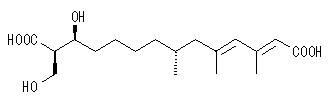
For Research Use Only. Not for human or veterinary use.
1233B
Product ID: BLK-0870
Structure
CAS
34668-61-6
Molecular Formula
C18H30O6
Molecular Weight
342.43
Price
1mg: USD 130.00 / 5mg: - / 25mg: -
Storage
-20°C
Solubility
1mg/ml ethanol, methanol, DMSO
Purity
>95%
Source Organism
Scopulariopsis sp.
Summary
1233B Opened lactone derivative of hymeglusin that modulates HMG-CoA synthase activity in the mevalonate pathway and is used in lipid metabolism research.
Details
Hymeglusin is a fungal polyketide containing a ?-lactone ring with defined stereochemistry and acts as a potent inhibitor of 3-hydroxy-3-methylglutaryl-CoA synthase. Mechanistic studies using radiolabeled hymeglusin demonstrated covalent binding to the catalytic Cys129 residue of cytosolic HMG-CoA synthase, resulting in complete enzymatic inhibition. Alkylating agents such as iodoacetamide and N-ethylmaleimide block hymeglusin binding, confirming thiol reactivity as the basis of inhibition. Biosynthetic investigations revealed that hymeglusin is assembled by a highly reducing polyketide synthase (HR-PKS), and the ketosynthase domain catalyzes ?-lactonization during chain termination. The ?-lactone moiety is essential for biological activity. Because HMG-CoA synthase catalyzes a key condensation step in the mevalonate pathway upstream of HMG-CoA reductase, hymeglusin and related derivatives such as 1233B provide mechanistically distinct tools for studying cholesterol biosynthesis, isoprenoid formation, and antimicrobial resistance modulation, including potential combination strategies against MRSA.
Mechanism
Covalent ?-lactone inhibitor of 3-hydroxy-3-methylglutaryl-CoA synthase (HMGCS) that reacts with the catalytic Cys129 thiol to form a stable thioester adduct, resulting in irreversible enzyme inactivation and blockade of the mevalonate pathway.